
From the archive
Jordan Peterson and Slavoj Žižek Ended Up with Much in Common

“Despite these contrasts, one of the striking things about the debate was how frequently Zizek and Peterson seemed to agree with one another.”
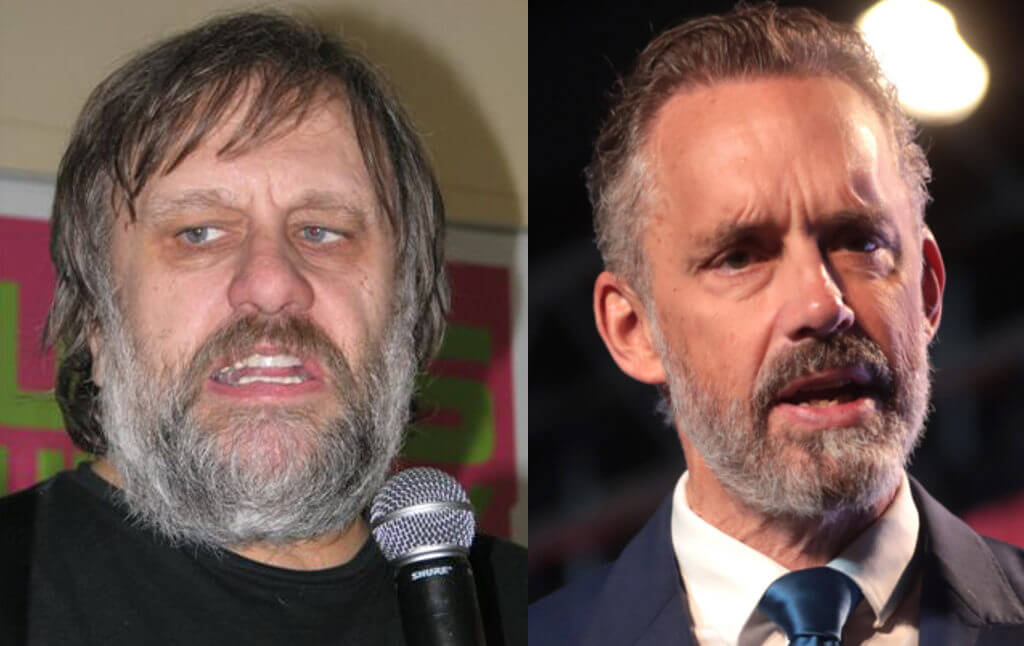
“Despite these contrasts, one of the striking things about the debate was how frequently Zizek and Peterson seemed to agree with one another.”
Introduction
Slavoj Žižek and Jordan Peterson cut two very different figures in their recent debate at the Sony Center in Toronto, Canada. The former was dressed in a T-shirt, and he was often hunched over, firing off dirty jokes and toilet humor. The latter was a model of svelte sophistication, well-dressed and consistently poised. As typical, Žižek went on more than a few extended tangents, occasionally giving off the airs of a freestyling poet decades younger. Peterson was far more modulated in his presentation, though sadly that analyticity didn’t always extend to his treatment of the subject at hand. Despite these contrasts, one of the striking things about the debate was how frequently Žižek and Peterson seemed to agree with one another. Indeed, one of the consistent criticisms of the debate was that it was disappointingly devoid of the antagonistic fireworks many were hoping for. Indeed, some critics have characterized it as a hubristic affair overall, more about stoking the egos and reputations of the participants than actually engaging in a serious discussion about political differences.
The Politics of Post-Modernity
I think there is something to these critiques, which will likely leave anyone looking for a clash of ideologies cold. The debate opened with Peterson’s extensive analysis of the Communist Manifesto, which, while clear, generally came across more as a stab at vulgar Marxism rather than the substantial positions of Marx himself. For instance, Peterson largely avoided dealing with Marx’s quite subtle observation in the Manifesto that more than any other social system, capitalism transforms the traditional societies around it. When “all that is holy is profaned” through capitalist processes, it may well make the search for “meaning” in the traditions Peterson admires quite challenging. He also misinterpreted Marx and Engels for apparently not engaging with the human relationship to nature, particularly their praise for how under capitalism, “subjection of nature’s forces to man” has reached an apex previous epochs like the feudal age could only dream of.
This, of course, reflects the deeper engagement with nature one finds in Marxist works like The German Ideology, which extensively details how the creative application of labor to the world distinguishes humans from (most) animals. Peterson was more convincing on the general point about capitalism producing a huge volume of material goods which have improved the global quality of life, but he was more dismissive when questions about its ability to handle environmental and demographic crises came up. He was also notably non-committal about how much state intervention can be justified to rectify inequality, which, of course, is a major political issue at this time. Peterson mostly brushed the issue off by suggesting that different states are experimenting with different levels of redistribution, which as I pointed out elsewhere evades the deeper question about whether one such model—or even one more radical—may well be the most just.
The rest is for members.
All proceeds go toward publishing more writers and poets.
Free for 30 days, then $3 a month
Become a member
This work is preserved in Merion West’s archive of articles and poems published from 2016 through early 2025. Explore the archive