
From the archive
Is “the Long Peace” Sustainable?

“Furthermore, one of the most—if not the most—crucial contributor to the Long Peace is the spread of democracy.”

“Furthermore, one of the most—if not the most—crucial contributor to the Long Peace is the spread of democracy.”
When one takes a look at media headlines, it might appear as though the world is plunging into chaos. The Coronavirus (COVID-19) outbreak, civil unrest, the threat of nuclear warfare, climate change, the revival of populism, nationalism, and authoritarianism, a “jobless” future, rising inequality, civil wars, terrorism, the Thucydides trap, hunger, poverty, and disease in developing countries—the list is endless.
With such headlines, it is not surprising that—according to a 2015 YouGov survey—only 6% of people in the United States, 4% of Brits and Germans, and 3% of the French believed that the world was getting better. This is all while facts show otherwise. On virtually all key dimensions of human life—such as poverty, health, literacy, etc.—the world is much, much better today than it was in the past. (Admittedly, while the ongoing COVID-19 pandemic may have undone parts of that progress, sooner or later the crisis will end.)

For example, every day, on average, more than 100,000 people are lifted out of poverty (since 1990). In 1950, 63% of the world population lived in extreme poverty; today, this number is less than 10%.
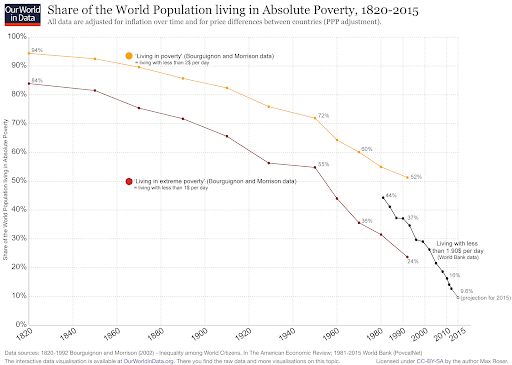
In fact, as Yuval N. Harari writes, “For the first time in human history, starvation kills fewer people than obesity; plagues kill fewer people than old age; and violence kills fewer people than accidents.”
The rest is for members.
All proceeds go toward publishing more writers and poets.
Free for 30 days, then $3 a month
Become a member
This work is preserved in Merion West’s archive of articles and poems published from 2016 through early 2025. Explore the archive