
From the archive
Will History See Another “New Nixon”?
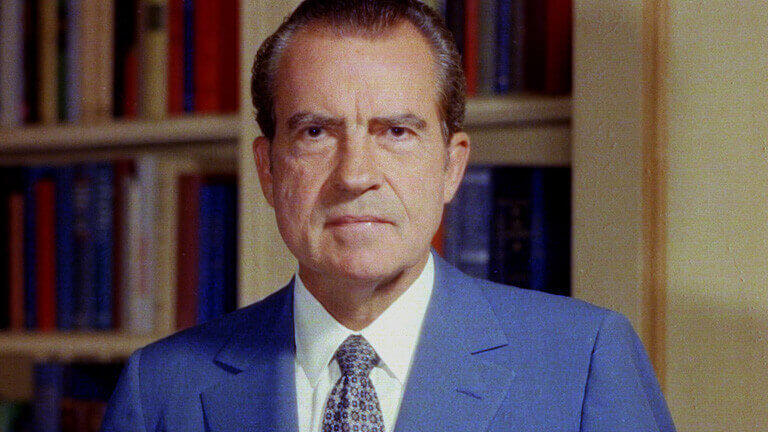
Richard Nixon spoke in Greensboro during his first presidential campaign in 1960, which ended in a narrow defeat to John F. Kennedy, “I always remember that whatever I have done in the past, or may do in the future, Duke University is responsible one way or the other.” Nixon earned a full scholarship to Duke’s Law School, and he would later become president of the Duke Student Bar Association and graduate third in his class. Duke first distanced itself from its most famous alumnus by rescinding an invitation to have Nixon speak at the 1954 Commencement after the faculty decided against awarding him an honorary degree. In the aftermath of Watergate, Terry Sanford, the Democratic former Governor of North Carolina and President of Duke, negotiated for Nixon’s Presidential Library to be built on campus. However, Duke’s Academic Council voted 35-34 to block its construction and thus disown its most notable, and most controversial alumnus.
However, we must remember the nobler side of Nixon: his choice to decline a full scholarship to Harvard to remain in California and provide for his younger brothers, his tenacious pursuit of the woman who repeatedly repudiated his advances before acquiescing and agreeing to marry him, and his vision for an enduring global peace.
If Richard Nixon were still living, he would be 100 years old, and his presidency continues to be marred by controversy. Although he was, at times, unable to uphold the morals that he knew to be indispensable, he was hardly the scoundrel that he is too often presented to be. Confronted by the burden of being the world’s most powerful man, he found himself so overwhelmed by how vulnerable his administration was to critique that he compromised his integrity. However, we must remember the nobler side of Nixon: his choice to decline a full scholarship to Harvard to remain in California and provide for his younger brothers, his tenacious pursuit of the woman who repeatedly repudiated his advances before acquiescing and agreeing to marry him, and his vision for an enduring global peace.
His father, Francis Nixon, owned “the poorest lemon ranch in California.” Two of his four brothers died of tuberculosis, while they were still young. Despite Nixon’s responsibilities which required him to drive a truck loaded with produce each morning to market, his excellent academic performance earned him a scholarship to Harvard. He declined in order to work at his father’s grocery store and support his younger siblings. Bob Dole spoke of Nixon’s determination during his eulogy for the former president, while standing in front of the house Francis Nixon built, “He was a grocer’s son who got ahead by working harder and longer than everyone else. How American. He was a student who met expenses by doing research at the law library for 35 cents an hour.”
The rest is for members.
All proceeds go toward publishing more writers and poets.
Free for 30 days, then $3 a month
Become a member
This work is preserved in Merion West’s archive of articles and poems published from 2016 through early 2025. Explore the archive